VibeDigest
Podcast libraryPricingFAQ

© 2026 VibeDigest. All rights reserved.

Privacy PolicyTerms of Service

Podcasts, already organized

Topics

All topicsAI AgentsAI CodingProductStartupsResearch

274 digests ready

AI Engineer

From VLM/VLA's to Embodied Agents — Armen Aghajanyan, Perceptron AI

Perceptron proposes an embodied foundation model that unifies perception, embodied reasoning, and control while allocating computation selectively across highly imbalanced multimodal data. The speaker claims this approach improves efficiency, robustness, and data scaling, including a reported 10-fold substitution between video pretraining and costly teleoperation data, although deployment readiness remains unresolved.

10 key points

View digestOriginal episode
a16z

Fei-Fei Li is Solving the Hardest Problem in Robotics | World Labs with a16z

10 key pointsOriginal episode
Latent Space

🔬Bio-security is an AI Arms Race - Eric Nguyen (CEO, Radical Numerics)

9 key pointsOriginal episode
AI Engineer

From Scratch to SOTA: Training a 3B State-Space Vision Model — Krishna Prasad Srinivasan, Sarvam

Sarvam argues that a sovereign, 3-billion-parameter state-space vision-language model can outperform far larger systems in Indian document intelligence by combining block-level OCR, multilingual pretraining, verifiable reinforcement learning, and a specialized data-and-evaluation engine. Its broader objective is to convert India’s largely un-digitized multilingual knowledge into reliable, locally controlled data.

9 key points

View digestOriginal episode
The Pragmatic Engineer

Design Engineering with Maggie Appleton

AI makes prototyping and implementation dramatically faster, but it does not replace the designer’s responsibility to frame the right problem, understand the medium, and exercise contextual judgment. The next major challenge is collaborative tooling that helps humans and agents make, explain, and preserve decisions together.

10 key points

View digestOriginal episode
a16z

Replit CEO Amjad Masad on What Young People Should Learn in the AI Era

Education should give young people the trust, freedom, resources, and ethical grounding to pursue deep curiosity rather than forcing them through standardized credentials or premature careers. In an AI-transformed world, the strongest model combines project-based exploration, human development, and respect for existing knowledge with permission to challenge it.

9 key points

View digestOriginal episode

More organized episodes

AI predictions: Job markets, Codex beats Claude, and the death of org charts | Dan Shipper
Lenny's Podcast

AI predictions: Job markets, Codex beats Claude, and the death of org charts | Dan Shipper

Dan Shipper predicts that AI will reorganize work without eliminating the need for humans: company-wide agents and agent-centered desktop environments will become common, while people shift toward directing, reviewing, and improving automated work. The biggest beneficiaries will be AI-fluent product managers, full-stack designers, engineers who build reliable agent systems, and anyone who continuously experiments with new models.

Building the Document Context Layer for AI Agents — Jerry Liu, LlamaIndex
AI Engineer

Building the Document Context Layer for AI Agents — Jerry Liu, LlamaIndex

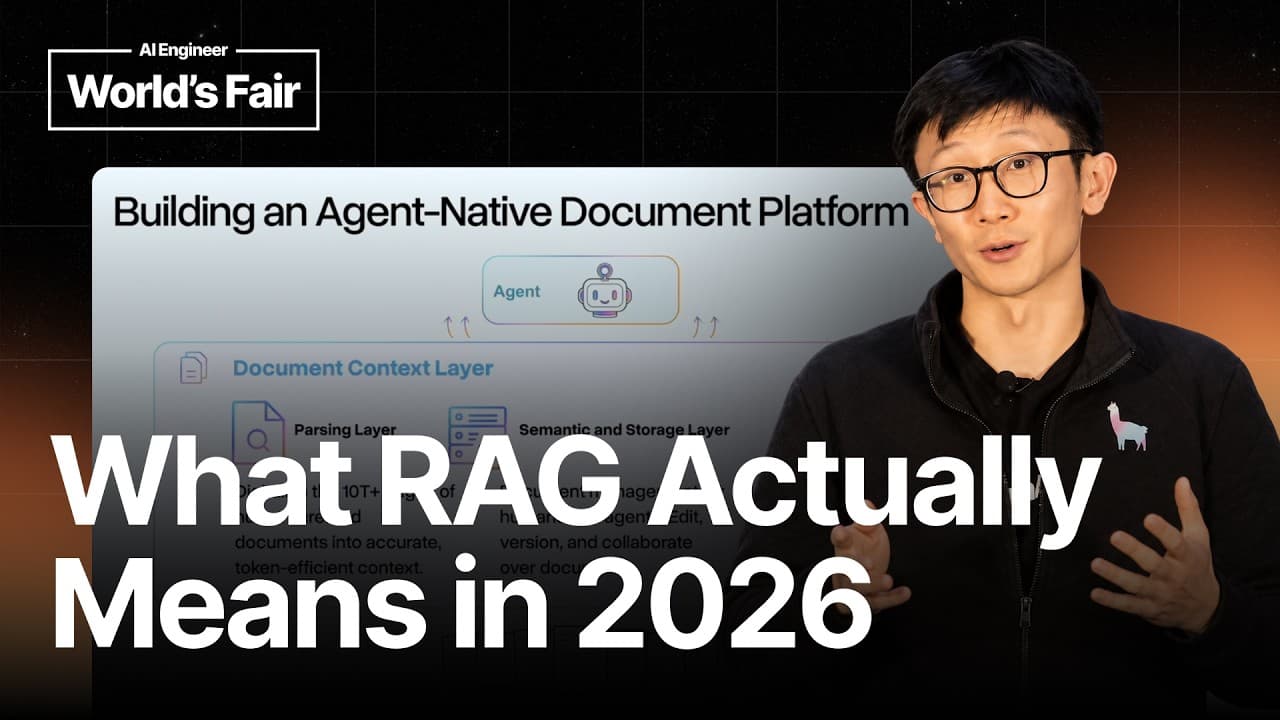
Modern RAG is no longer a fixed retrieval pipeline; it combines an increasingly capable agent with a document context layer that parses, stores, searches, and operationalizes unstructured information. Effective document infrastructure must balance accuracy, cost, and latency through specialized and hybrid parsing strategies.

🔬 "The Most Innovative Diffusion Research Is Happening in Drug Discovery, Not Image Generation"
Latent Space

🔬 "The Most Innovative Diffusion Research Is Happening in Drug Discovery, Not Image Generation"

Genesis Molecular AI argues that useful AI drug discovery depends on sub-angstrom structural accuracy, physics-guided diffusion, synthetic data, and rapid laboratory feedback—not structure prediction alone. Its long-term goal is to turn validated molecular models into agentic systems that let scientists direct many parallel drug-design campaigns.

I Gave an AI a Body — Cyrus Clarke, MIT Media Lab
AI Engineer

I Gave an AI a Body — Cyrus Clarke, MIT Media Lab

Cyrus Clarke’s experiments suggest that embodied AI can become more expressive and conversational without adopting human or animal form. His shape-display agent uses a learned gesture vocabulary to reduce latency and create a sensory, emotionally legible relationship with people.

The arrival of AGI | Shane Legg (co-founder of DeepMind)
Google DeepMind

The arrival of AGI | Shane Legg (co-founder of DeepMind)

Shane Legg expects minimal AGI within a few years and full AGI within a decade, followed eventually by superintelligence. The central challenge is not only making increasingly capable systems safe, but redesigning economic and social institutions so their benefits are broadly shared.

🔬 Google's AI Scientist Started as an Attempt to Automate Kaggle — John Platt, Google Fellow
Latent Space

🔬 Google's AI Scientist Started as an Attempt to Automate Kaggle — John Platt, Google Fellow

ERA turns scientific questions into scorable coding tasks and uses Gemini-guided search to improve candidate solutions. Its power increases rather than removes the need for human creativity, domain knowledge, hidden holdouts, and rigorous validation.

Why Education Has to Change
a16z

Why Education Has to Change

Horowitz and Gagan Academy is designed as an AI-era alternative to conventional higher education for young builders, combining project-based learning, peer community, and direct exposure to Silicon Valley companies. Its core wager is that students will learn faster by building consequential things than by preparing for tests within a system designed for the industrial age.

Harness Engineering: Building the Production Cage for Powerful Domain Agents — Mike Chambers, AWS
AI Engineer

Harness Engineering: Building the Production Cage for Powerful Domain Agents — Mike Chambers, AWS

Production-grade agents require more than a model, prompt, and tools: their harness must independently manage runtime, memory, identity, scaling, observability, evaluation, and deployment. AWS Bedrock AgentCore is presented as a composable way to supply that infrastructure without forcing developers to build every component themselves.

Why Rust is different, with Alice Ryhl
The Pragmatic Engineer

Why Rust is different, with Alice Ryhl

Rust combines low-level performance with compile-time protections against memory errors, null misuse, ignored failures, and incomplete refactors. Its ownership model creates a learning curve, but its tooling, compatibility strategy, and consensus-driven governance make reliability a system-wide property rather than a single feature.

David Reich – Bronze Age shock, the Neanderthal puzzle, & the sudden spread of farming
Dwarkesh Patel

David Reich – Bronze Age shock, the Neanderthal puzzle, & the sudden spread of farming

A new ancient-DNA method suggests that directional natural selection was widespread in Europe and the Middle East over the last 18,000 years, with especially strong immune and metabolic adaptation during the Bronze Age. Most observed allele-frequency change still came from migration and genetic drift, and many provocative trait-level findings require cautious interpretation.

Why I couldn't build Jev at OpenAI — Diogo Almeida, TypeSafe Co-founder & CEO
Latent Space

Why I couldn't build Jev at OpenAI — Diogo Almeida, TypeSafe Co-founder & CEO

Typesafe’s thesis is that AI will create more economic value when optimized as reliable, programmable infrastructure for software rather than as a human-facing chatbot. Its first model, Jev, prioritizes intelligence per dollar, calibrated decisions, structured inputs, and composability, while treating reliability—not benchmark performance—as the central constraint on automation.

The Dark Arts of Skill Engineering — Paul Bakaus, Renaissance Geek (Impeccable)
AI Engineer

The Dark Arts of Skill Engineering — Paul Bakaus, Renaissance Geek (Impeccable)

Reliable skills are harness extensions, not packaged prompts. They combine adversarial agents, deterministic checks, memory, scripts, hooks, interactive tools, cross-harness compilation, and model-specific enforcement.

Load more